
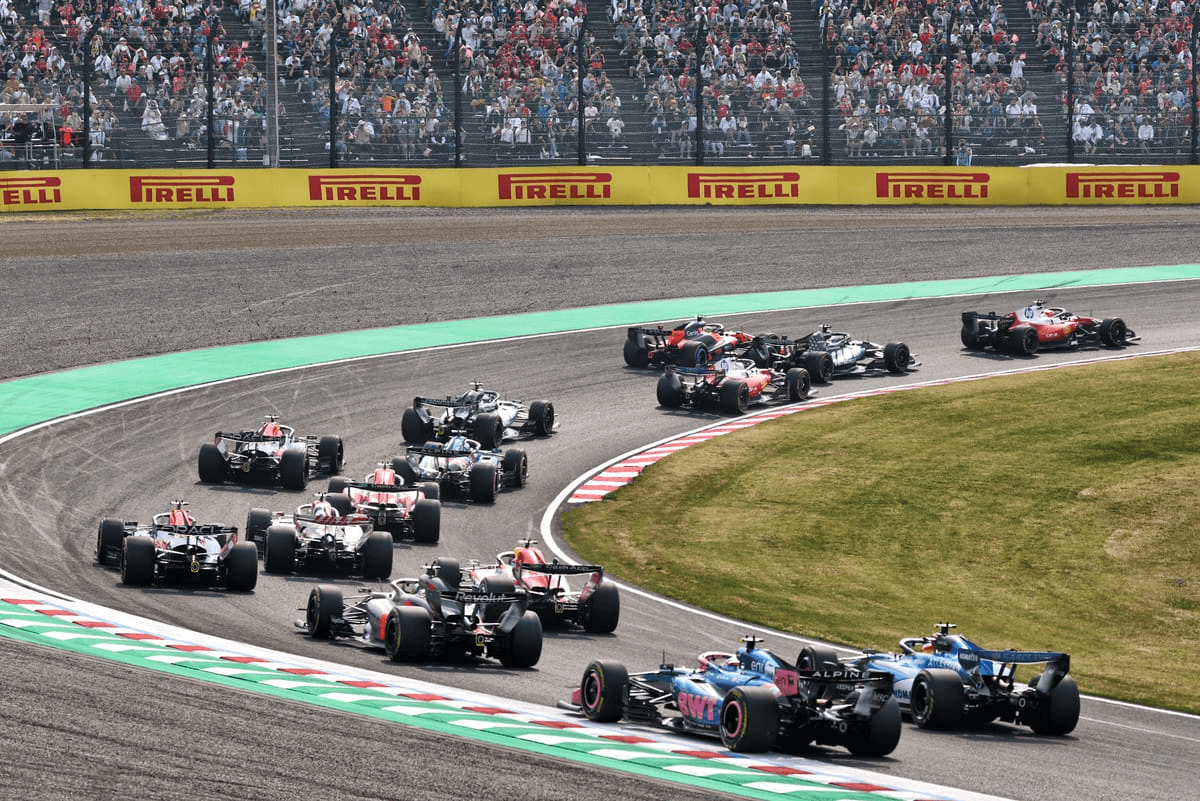
Japanese GP 2026: Full Race Breakdown
Kimi Antonelli crossed the line at Suzuka to take his second consecutive win of the 2026 season, and in doing so became the youngest driver in Formula 1 history to lead the Drivers' Championship. This race recap covers every key moment: how the 19-year-old Mercedes driver built a nine-point gap over teammate George Russell across 53 laps that punished teams who got their strategy wrong and rewarded the ones who read the safety car perfectly.
Suzuka threw its usual curveballs. The circuit's repaved asphalt sections had engineers watching degradation data all weekend, with tyre behaviour shifting just enough from historical baselines to make pre-race models unreliable. When a 50G crash on lap 22 froze the strategic picture, the teams that had already committed to their plans were exposed. The one that hadn't yet pulled the trigger walked away with the win.
Race Result and Podium
Antonelli crossed the line 13.722 seconds ahead of Oscar Piastri (McLaren), with Charles Leclerc (Ferrari) a further 1.548 seconds back in third. George Russell finished fourth for Mercedes, Lando Norris fifth, and Lewis Hamilton sixth for Ferrari. The top six was covered by 25 seconds, which tells you how clean and controlled the second half of this race was once the safety car period resolved itself.
The constructor points haul was significant. Mercedes banked 37 points on the day (Antonelli's 25 plus Russell's 12), McLaren collected 28 (Piastri's 18 and Norris's 10), and Ferrari took 23 (Leclerc's 15 and Hamilton's 8). Max Verstappen finished eighth for Red Bull, scoring four points and continuing a difficult weekend that started with a shock Q2 exit.
For the full results and standings from Suzuka, see the comprehensive classification and points breakdown.
DNFs and Retirements
Lance Stroll (Aston Martin) retired on lap 31, consistent with the mechanical fragility the team has shown throughout the early 2026 season. Oliver Bearman (Haas) was the other retirement, and his exit was anything but quiet — it became the defining moment of this race.
The Lap 22 Crash That Reshuffled the Entire Race
Bearman's 50G Impact at Spoon Corner
On lap 22, Bearman was caught completely off guard by the closing speed of Franco Colapinto's Alpine into Spoon corner. He ran onto the grass, lost the car, and hit the outside wall at an impact measured at 50G. He walked away from the wreckage with a right knee contusion and no fractures, which, given the force involved, shows how well these 2026 chassis are built to handle impacts like that.
The deployment came at exactly the most sensitive point in the strategic window. Piastri had already pitted on lap 18-19. Russell had pitted on lap 21, emerging on fresh hard tyres. Both were running on compound they had just fitted. The race order at the moment the safety car board went out had Piastri ahead, Russell behind him, and Antonelli still out front on his original set of mediums, yet to make his stop.
How Antonelli Turned the Safety Car into a Race-Winning Opportunity
Antonelli pitted under yellow, and the timing made it essentially free. The safety car delta compressed the real-time cost of the stop to almost nothing. He emerged from the pit lane with fresh hard tyres and, crucially, track position he could not have secured during a green-flag stop. Both Piastri and Russell were now behind him. He had leapfrogged both drivers without a single wheel-to-wheel fight.
The safety car period ran until the end of lap 27. When racing resumed, Antonelli controlled the gap from the front with exactly the composure Mercedes will want to see from their championship leader.
Tyre Strategy and the One-Stop Window
Why the Medium-to-Hard Plan Dominated
The available compounds for the 2026 Japanese GP were C1 (Hard), C2 (Medium), and C3 (Soft). The dominant strategy was a single stop: start on the C2 Medium and transition to the C1 Hard for a long run to the flag. Pre-race modelling suggested a switch around laps 18-22, which is exactly where most of the field landed.
The newly resurfaced sections of the Suzuka circuit reduced tyre wear slightly compared to prior years, making the one-stop even more viable than engineers had initially projected. Teams running the softer C3 compound at the start found themselves committed to an earlier pit window, which ultimately worked against them once the safety car arrived. For more on how compound selection interacts with Suzuka, check our tyre strategy explainer.
Who Gained and Who Lost in the Pit Stop Shuffle
Antonelli gained track position cleanly. Russell, already on the hard compound after a lap 21 stop, found himself behind his teammate on a fresher set of the same tyre and could not recover during the restart. The gap between them at the flag was just 0.484 seconds, but Antonelli never gave him the opportunity to challenge for the lead.
Piastri maintained P2 but could not mount a genuine challenge on Antonelli after the restart. Hamilton's restart move on Russell for P3 was aggressive and briefly successful, but Leclerc ultimately settled the podium order.
Performances That Stood Out
Verstappen's Damage Limitation After His Q2 Exit
Verstappen's Q2 elimination was qualifying's biggest shock. The Red Bull suffered a balance swing from understeer to oversteer through the Esses that left him unable to string together a clean lap. Starting from the middle of the grid at a circuit that, on paper, should suit Red Bull's high-downforce philosophy made P8 a frustrating but arguably maximum-available result.
The weekend-long handling issues raise a bigger question about Red Bull's 2026 setup correlation. A circuit that rewards mechanical grip and stable aero should be in their wheelhouse. The fact that it wasn't signals either a setup misstep or a deeper issue with how the new regulations interact with their car concept.
Piastri's Pace, Hamilton's Restart Move, and the Midfield Runners
Piastri was arguably the fastest car on track for significant portions of the race. Without the safety car timing working against him, a McLaren win was entirely realistic. Hamilton's overtake on Russell at the restart was clean and aggressive — a reminder that the 2026 Ferrari package is now genuinely competitive in race trim.
Lower down the order, Pierre Gasly delivered P7 for Alpine, Liam Lawson took P9 for Racing Bulls continuing a run of results that keeps that team quietly relevant in the midfield constructors' battle, and Esteban Ocon took P10 as Haas's only classified scorer after Bearman's crash.
What the Japanese GP Means for the Title Race
Antonelli's Nine-Point Championship Lead
Antonelli now leads the Drivers' Championship with 72 points. Russell sits second with 63. Nine points is nothing over a 24-race season, and Russell's pace and consistency mean this fight is nowhere near settled. But the psychological dynamic has shifted. Antonelli is no longer the promising rookie holding station behind an established teammate — he is the championship leader.
Constructors' Picture and the Season Ahead
Mercedes lead with 135 points, Ferrari sit second with 90, and McLaren hold third with 46. Red Bull are in an uncomfortable position — their 16 points from three races puts them level with Alpine and just two ahead of Racing Bulls. For a team with their resource base, that is a results deficit they will want to address immediately.
The title fight heading into the next round is genuinely open across both championships. The pattern of this season is clear: execution under pressure separates the frontrunners. Antonelli is currently doing that better than anyone. For background on his emergence earlier this year, see our 2026 Chinese GP: Antonelli's Maiden Win.
The Bottom Line from Suzuka
This race comes down to one inflection point: Bearman's lap 22 crash. Antonelli wins, the safety car was the strategic hinge, and Mercedes now hold both the Drivers' and Constructors' leads after three rounds. The title fight is wide open with Russell nine points back, Ferrari building momentum, and McLaren capable of winning races when strategy breaks their way. Red Bull's Suzuka weekend was a quiet alarm bell the paddock will not ignore.
The 2026 season is delivering exactly the multi-team fight the regulation reset was designed to create. If this race teaches us anything, it is that track position under a safety car is as valuable as raw pace, and the teams that understand those inflection points will be the ones lifting trophies in December.