
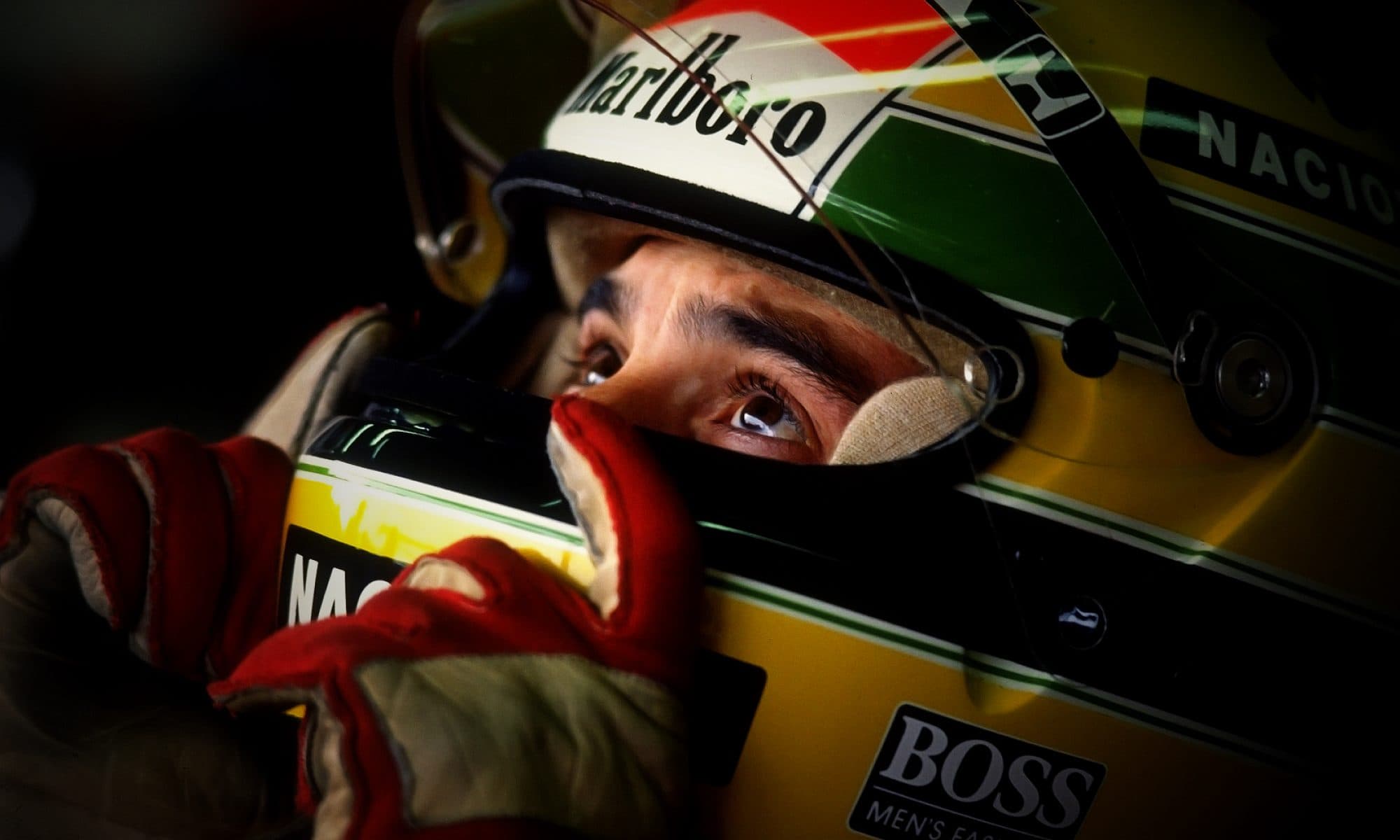
Ayrton Senna: Brazil's F1 Legend Explained
In Brazil, Formula 1 isn't just a sport you watch on weekends. It's a cultural inheritance, passed down through conversations, through the weight in a São Paulo crowd's roar at Interlagos, through the way older fans go quiet when certain dates come up. Ayrton Senna is the reason for all of that. You can follow every race in the 2026 season without knowing his name, but you'll miss half of what you're actually watching. At GridLine Club, we cover the current season with the full weight of that history behind us, because the passion driving Brazilian fans to their screens today runs directly through one driver from São Paulo.
This article gives you everything you need to understand why: the career numbers, the races that proved he was operating at a different level, the rivalry that divided the paddock for three years, and the crash that forced motorsport to rebuild itself from the ground up. Whether you're new to Formula 1 or looking to put what you already know in sharper focus, this is where to start.
From São Paulo to the Formula 1 Grid: Ayrton Senna's Early Career
Early life and junior career
Ayrton Senna was born in 1960 in São Paulo into a prominent Brazilian family. His father Milton owned a farm and a metalworking business, but that background didn't explain what came next. He was karting at 13 and won his first race immediately. By his late teens, he had taken the South American Kart Championship twice and finished runner-up at the Karting World Championship twice. He moved to Britain in 1981, dominated Formula Ford and Formula Three over three seasons, and arrived in Formula 1 with Toleman in 1984 with a point already made: he was not there to develop gradually.
Three World Championship titles followed, in 1988, 1990, and 1991. He drove for Toleman, Lotus, McLaren, and finally Williams. His career statistics describe a driver who treated every session as a qualifying lap: 161 starts, 41 wins, 65 pole positions, 80 podiums, and 614 championship points (per official Formula 1 records). He started from the front row in 53.7% of his career races. That's not dominance in qualifying; that's control of it.
The Three Championship Seasons
The 1988 season with McLaren was close to total. Senna won 8 of 16 races in the MP4/4, a car so fast it embarrassed the field. The 1990 title came through a controversial collision at Suzuka that we'll address shortly. The 1991 championship was something different entirely: Senna pushed a McLaren that had no business winning a title to seven victories in a season where, by most contemporaneous assessments and race-by-race performance data, Williams had the more competitive machinery across several rounds. He finished the title fight 24 points ahead of Nigel Mansell, a margin that tells you more about the driver than the constructor. That gap between raw ability and what the machinery could reasonably deliver has rarely been illustrated more clearly in a single season.
The Races That Separated Ayrton Senna from Everyone Else
Two performances come up in every serious conversation about the greatest drives in Formula 1 history. The first is his qualifying lap at Monaco in 1988. Senna's pole time was 1.427 seconds faster than Alain Prost, his teammate, on the same car, on the same dry track. Prost was no ordinary benchmark. That gap remains the most analyzed single qualifying lap in the sport's history. Senna described entering a different mental state during the lap, a level of focus where conscious decision-making fell away. It still doesn't sound like an exaggeration when you look at the time sheet; McLaren's own account of that qualifying lap at Monaco in 1988 is one of the more detailed contemporary appreciations of what happened that weekend.
The second is the 1993 European Grand Prix at Donington Park. Starting fourth in a McLaren that had no realistic business competing with the Williams cars that season, Senna made four overtakes on the first wet lap and led before the end of it. He won by over a minute. Against Prost and Damon Hill in machinery that outclassed his own, in rain, Senna simply removed the technical conversation from the result. That race is why the word "masterclass" gets overused and why it occasionally still earns its keep. His career and race records are collected and summarized on comprehensive driver archives such as the Ayrton Senna profile at Formula One History.
Both performances are documented in detail in the 2010 documentary Senna, directed by Asif Kapadia, still the most widely seen portrait of his career and a useful companion to the race records.
Senna and Prost: Teammates Who Became Something Else Entirely
Prost drove Senna to the airport when they first met in 1984. By 1989, they were no longer on speaking terms. The collapse happened over three seasons at McLaren, where proximity turned competitive anxiety into something that shaped regulations, politics, and outcomes across the entire sport. McLaren's chief designer Neil Oatley noted that both drivers were so concerned about being outperformed that they mirrored each other's car setups. Neither explored what might genuinely work best for him individually.
The 1989 San Marino Grand Prix at Imola saw them collide at the chicane, effectively ending Senna's championship that year. The 1990 Japanese Grand Prix at Suzuka was worse. Senna later admitted he deliberately drove into Prost at the first corner to secure the title. It was calculated, not accidental, and it worked. Evaluating it fairly means acknowledging both things simultaneously: it was a ruthless act, and it came from a driver who felt the sport had already failed to protect him from similar tactics.
Prost retired after 1993. In the months between that retirement and May 1994, the two had begun rebuilding something genuine. Prost was at Imola that weekend working for French television. During practice, Senna had radioed a message sending "a special hello to my dear, our dear friend, Alain." After the crash, Prost said a part of him had died alongside Senna. The rivalry had been real, but so had the friendship they were building when it ended.
Imola 1994: The Crash That Changed Formula 1
The weekend and the accident
The San Marino Grand Prix weekend had already claimed Roland Ratzenberger's life in Saturday qualifying. His death was the first at a Formula 1 race weekend in over a decade, and it registered as a warning that went unheeded before Sunday even began.
On lap 7 of the race, Ayrton Senna's Williams FW16 left the road at Tamburello corner at approximately 211 km/h and struck a concrete wall. He received treatment trackside, was airlifted to hospital, and was declared dead that afternoon. Rubens Barrichello had crashed heavily in practice. Four mechanics were injured later in the race when a loose wheel left Michele Alboreto's pit stop. The weekend was a concentration of catastrophe that F1 had been accumulating toward without formally acknowledging, a point underscored by the volume of pre-1994 safety debates that had gone unresolved in the sport's governance structures.
The investigation and its findings
The Italian investigation concluded that a steering column modification had failed under load. Senna had requested the column be shortened because his knuckles rubbed against the chassis using his preferred steering wheel. Williams accommodated the request by reducing the column's diameter in a critical area rather than lowering it. A University of Bologna expert described the modification as poorly designed, with structural weaknesses at the point of maximum stress and damage from the machining process. The Italian Supreme Court ultimately found Williams technical director Patrick Head responsible, though the case had exceeded the statute of limitations by the time of the ruling. No evidence supported driver error as a primary cause.
The Legacy That Outlasted Him
The safety changes that followed Imola were significant and lasting. Chicanes were added at Tamburello. Wheel tethers were introduced. Cockpit sides were raised. The Grand Prix Drivers' Association, dormant for 12 years, was reformed that same afternoon. The HANS device became mandatory in 2003. Formula 1 went 20 years without a race fatality, until Jules Bianchi in 2014. That record came directly from what Imola forced the sport to confront; the sport's own reflection on Imola 1994 and its safety legacy is summarized in an analysis at Formula1.com's Imola 1994 safety retrospective. The evolution continued through the pioneering comeback stories like Niki Lauda's 1976 return, which had already pushed the sport toward confronting its limits.
Before the crash, Senna had spoken with his sister Viviane about creating systematic programs for underprivileged children in Brazil. The family turned that conversation into the Instituto Ayrton Senna, founded in November 1994. In three decades, the organization has provided 39 million student services across more than 3,000 cities in all 27 Brazilian states, working exclusively with public school networks on literacy, socio-emotional learning, and teacher development. UNESCO granted the institute a Chair in Education and Human Development, the first ever awarded to an NGO worldwide. It's how Senna's name exists in communities that never watched a race. Learn more about the institute's work at the Instituto Ayrton Senna website.
Why Ayrton Senna's History Matters for the 2026 Season
Senna's story isn't archived material. It's the foundation that Brazilian F1 culture stands on. When you watch the crowd at Interlagos respond to a podium, or see Brazilian drivers like Gabriel Bortoleto and Felipe Drugovich navigate the pressure of carrying their country's F1 hopes, the emotional register in that moment runs directly back to him. Understanding what he did, and what was lost at Imola, gives you the full context for why this sport means what it means in Brazil.
The 2026 season is the latest chapter in a story that started decades ago in São Paulo. Ayrton Senna built something that outlasted his career, his rivalry with Prost, and even his life, and it still shapes every race weekend at Interlagos today. GridLine Club's coverage combines the technical and strategic depth of the current championship with the historical perspective that explains why those moments land the way they do. If you'd like a concise introduction to who we are and why we approach the sport this way, see our About GridLine Club page; and to follow our ongoing season coverage directly, visit GridLine Club.