Niki Lauda 1976: 40 Days That Changed F1
August 1, 1976. Lap 2 of the German Grand Prix. Niki Lauda's Ferrari 312T2 snaps right just before Bergwerk corner, hits the barriers, and bounces back onto the circuit. It is on fire. No trained marshals reach it. Four fellow drivers climb out of their own cars and drag the man inside out of the wreckage with their bare hands.
That man is the reigning Formula 1 World Champion, points leader by 26 over his closest rival, and the most methodical, technically precise driver on the grid. And in that moment, given last rites in a German hospital, Niki Lauda is expected to die.
What happened next is not just a survival story. It is a study in what separates the sport's great competitors from everyone else. Thirty-five days later, Lauda was back in a race car. Stories like this one are exactly why GridLine Club exists: because Formula 1's present makes no sense without its past.
Before the fire: the 1975 champion who had everything
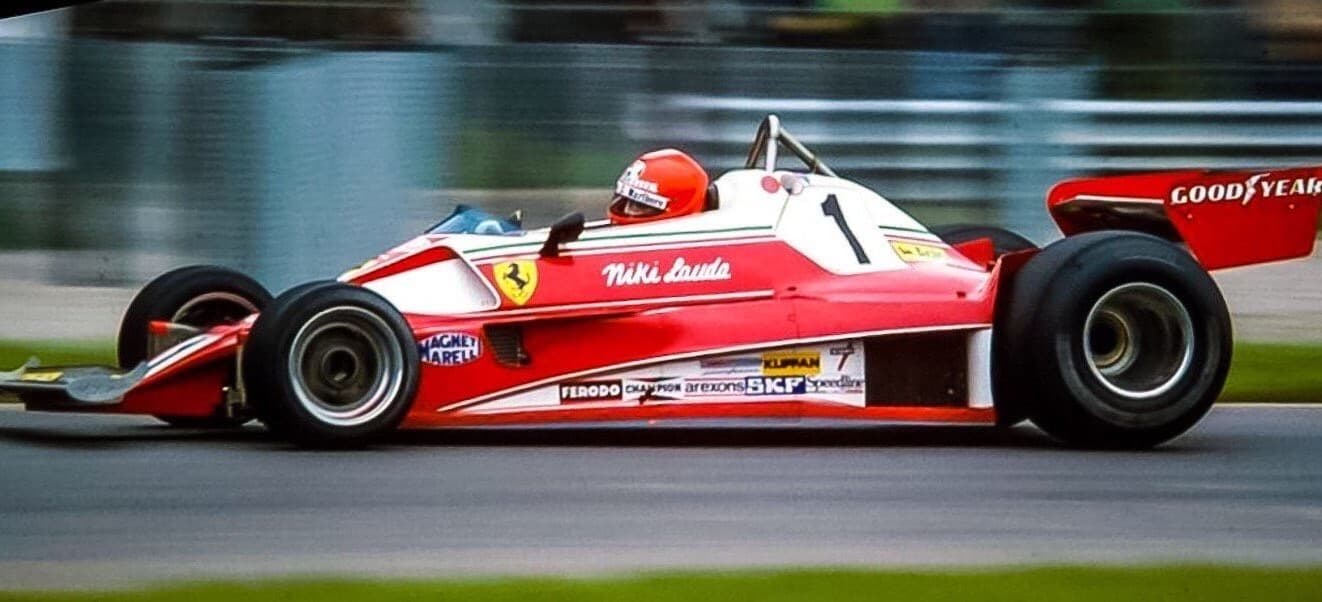
Lauda arrived at Ferrari in 1974 with a reputation for relentless technical feedback and obsessive testing. He wasn't just fast; he could explain exactly why the car was fast or slow and what engineers needed to change. That combination of speed and precision was rare. Ferrari noticed immediately.
The Ferrari 312T, introduced in 1975, featured a transverse gearbox that repositioned mass closer to the car's center. The handling improvement was significant, and Lauda extracted everything from it. He won five races that year, claimed his first World Championship, and delivered Ferrari their first Constructors' title in over a decade alongside Clay Regazzoni. A career that would ultimately yield 25 wins, 54 podiums, 24 pole positions, and three world titles, across what most sources record as around 171 Formula 1 starts, was already looking inevitable.
Heading into 1976, he was the clear championship favorite, a status the 26-point lead over James Hunt made concrete. Hunt, the McLaren driver, was everything Lauda wasn't: charismatic, unpredictable, and magnetic in front of a camera. Lauda optimized. Hunt improvised. The contrast made for a rivalry the sport hadn't seen in years. The title, by any rational measure, was Lauda's to lose.
Niki Lauda and the Nürburgring: the crash and the drivers who pulled him out
The Nürburgring Nordschleife in 1976 stretched 22.8 kilometers through the Eifel mountains with minimal safety infrastructure, inadequate fire coverage, and no realistic medical response plan for a remote crash. Lauda knew this. He pushed hard for a full driver boycott before the race. The vote failed by one. He started anyway.
On lap 2, his Ferrari lost control just before Bergwerk corner during the 1976 German Grand Prix. It struck the barriers, bounced back into traffic, and was hit by at least two other cars. The fuel tank ruptured. The car was engulfed. His helmet, a modified fit, slipped off and exposed his face directly to the fire. No marshals reached him. Drivers Guy Edwards, Brett Lunger, Harald Ertl, and Arturo Merzario stopped their own cars and pulled Lauda from the wreckage while it burned.
He was conscious briefly, then fell into a coma. The injuries were severe: burns to his face, scalp, arms, and hands; lungs damaged by toxic smoke inhalation; eyelids and ears requiring later reconstructive surgery. He had lost roughly 10 kilograms. A priest administered last rites. Ferrari brought in Carlos Reutemann to replace him. Hunt, racing every week Lauda missed, closed the championship gap with each passing round.
Niki Lauda's return: five weeks and a fourth place at Monza
Thirty-five days after the crash, returning on September 5, 1976, Lauda first drove to Ferrari's Fiorano test circuit. His initial laps were slow. The seat harness pressed against wounds that hadn't fully closed. He adjusted the belts, found a position that worked, and immediately began approaching the lap record. He then called Enzo Ferrari and told him he was ready to race. No sentiment. No drama. Just evidence.
The Italian Grand Prix at Monza ran on September 5, 1976. Lauda qualified. He started. His bandages soaked through during the race. His vision was partially compromised by injuries that still hadn't healed. He finished fourth. That result closed the gap on Hunt in the standings and told every team on the grid that the 1976 championship was not decided. Fourth place at Monza remains one of the most remarkable results in the sport's history, not because of the points it scored, but because of what it cost to score them.
Japan 1976: the calculation that defined his legacy
The season came down to the final race: the Japanese Grand Prix at Fuji Speedway. Torrential rain. Black clouds. Standing water on the circuit and near-zero visibility for open-cockpit cars. After two laps, Lauda pulled into the pit lane and retired. Hunt finished third and won the World Championship by a single point.
Some framed that decision as defeat. Lauda never did. He had already watched a circuit kill people. He had nearly died himself. He looked at the conditions at Fuji and made the same cold, precise calculation he applied to every other variable in a race weekend. The risk was unacceptable. He drew the line. The sport, in 1976, had not yet drawn it for itself.
He won his second championship in 1977 and his third with McLaren in 1984, a season so dominant that he and Alain Prost together won 12 of 16 races. The retirement in Japan was not the end of Lauda's story. It was one decision in a career defined by exactly this kind of thinking.
The Rush film, the legacy, and why it matters in 2026
Ron Howard's Rush (2013) covers the full 1976 season. Daniel Brühl spent significant time with Lauda himself to capture his accent and manner, and wore prosthetic teeth to match the driver's distinctive appearance. Lauda rated the finished film 80 percent accurate. His favorite detail: the film ends with Hunt "going partying" and Lauda returning "to Ferrari and work," which Lauda said captured "this so-called friendship" exactly right. For more on Brühl's preparation, see the interview with the actor.
The crash at Bergwerk also changed Formula 1 in structural, lasting ways. The FIA introduced regulations in 1976 and 1979 addressing cockpit extraction standards, helmet fire coverage, piped air supply to drivers, and onboard fire suppression systems. The Nürburgring Nordschleife was removed from the calendar in 1977. These weren't minor adjustments. They were the beginning of a safety evolution that has continued through every subsequent decade, its logic visible in the cockpit protection standards and marshal protocols that govern racing today.
Niki Lauda went on to found Lauda Air, take on the Jaguar team principal role in 2001, and serve as non-executive chairman of Mercedes from 2012 until his death in May 2019, a period that saw the team win six consecutive Constructors' Championships. Every role he held, he approached the same way he tested at Fiorano five weeks after nearly dying: find what works, remove what doesn't, and get back in the car.
At GridLine Club, covering the 2026 season means understanding why the sport looks the way it does. The current cars, the safety standards, the culture of precision in race engineering, all of it traces back through moments like this one. Niki Lauda's 1976 comeback isn't remarkable because he survived. It's remarkable because of what he chose to do with the 35 days that followed. That thread runs through every corner of the modern sport. Follow it with us.