
Why Mercedes Is So Fast in 2026
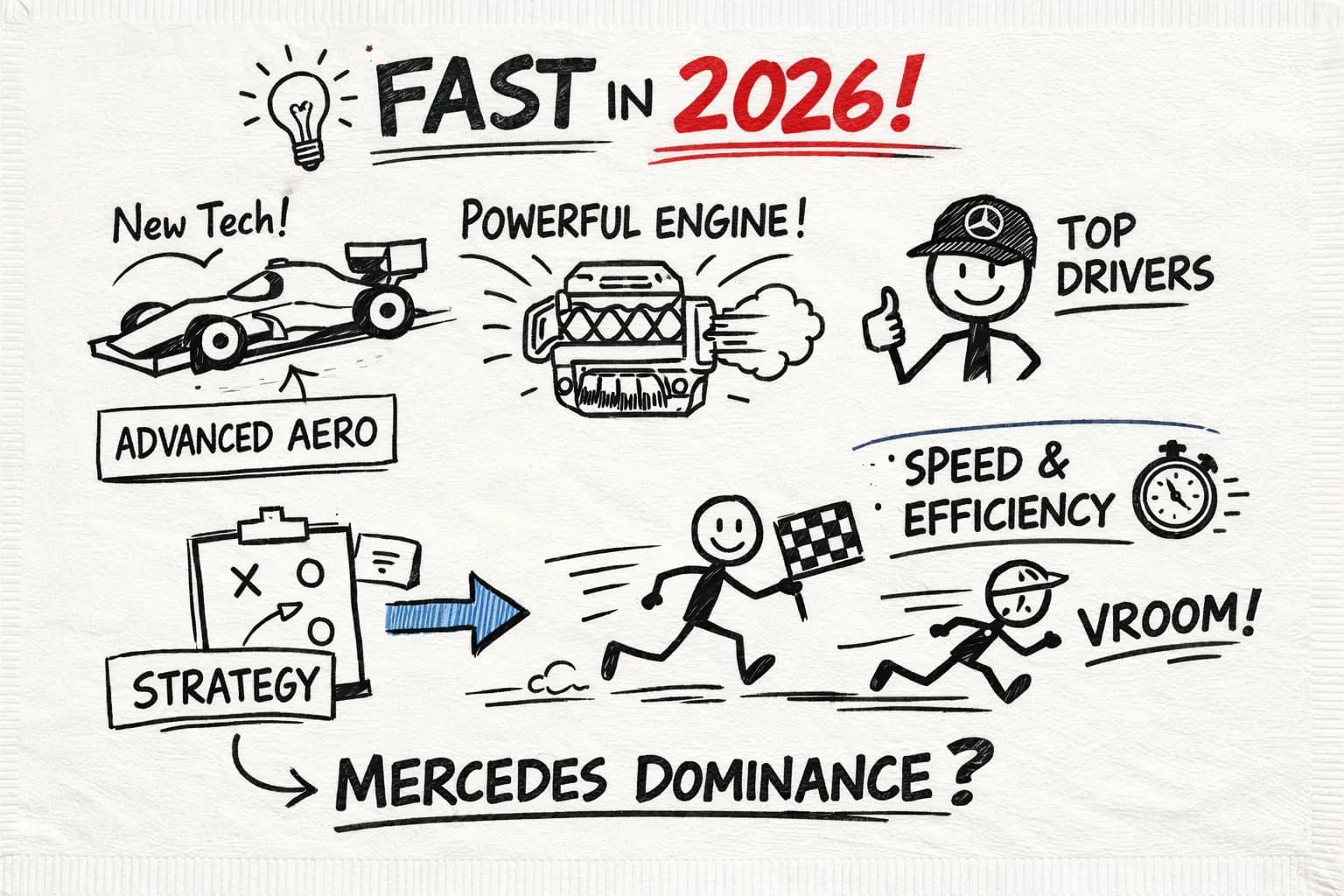
Three races, three Mercedes wins, two 1-2 finishes. Russell won in Australia by 15.5 seconds. Antonelli claimed his maiden win with a 1-2 in China. And at Suzuka, Antonelli won again despite a safety car and mid-pack chaos. In F1, where a tenth of a second separates grid positions, this level of dominance doesn't happen by accident. The answer lies in four pillars: engine, active aero, battery management, and car-driver integration.
The engine: the compression loophole
The 2026 MGU-K delivers 350kW — nearly three times more than before. The FIA set a 16:1 compression ratio limit. But Mercedes used a pre-chamber engine design that allows effective ratios of up to 18:1 at operating temperature (~130°C), while the cold measurement stayed within the legal limit. Result: approximately 10kW of extra combustion power. To understand how the 2026 regulations reshaped engine rules, see our dedicated article.
The FIA has already responded: from June, compression will be measured at both ambient and operating temperature. From 2027, only the hot measurement counts. Until then, Mercedes has a legal advantage window no rival can replicate.
Customer teams like McLaren and Williams run the same Mercedes engine but showed a ~0.3 second qualifying deficit in Australia — not from different hardware, but from operational knowledge gaps only the factory team possesses.
Super-clipping: the battery software nobody has copied
This is the heart of Mercedes' 2026 advantage. While other teams use lift-and-coast (lifting off the throttle before corners) to recharge the battery, Mercedes developed an approach called super-clipping: aggressive energy recovery while maintaining full throttle, typically at the end of straights. See how super-clipping works in detail.
In practice, this means:
- The turbocharged V6 operates in a more efficient power band
- Less turbo lag on corner exits
- Electrical energy available on straights when rivals are still recharging
- The advantage compounds across the entire lap, not in a specific sector
Rivals took time to diagnose this precisely because the gain doesn't appear in any single sector — it's only visible in full-lap overlays. Lift-and-coast costs time at corner entry. Super-clipping costs a marginal fraction of straight-line speed but preserves lap time structure in a way that compounds over an entire race stint.
Mercedes fluidly switches between Overtake Mode (extra energy within 1 second of a rival), Boost Mode (driver-initiated deployment), and Recharge Mode (braking). This ability is a product of the holistic architecture, not a software patch.
Ferrari: aero on par, battery falling short
Ferrari is the only team genuinely challenging Mercedes through corners. The SF-26 has competitive downforce at medium and high speeds — at Suzuka and Shanghai, Leclerc and Hamilton showed apex speeds very close to Mercedes.
The problem is energy. Ferrari's power unit suffers from a battery recovery deficit. Where Mercedes uses super-clipping to keep electrical charge available all lap, Ferrari enters straights with partially depleted battery, forcing more lift-and-coast. This costs time at corner entries and reduces deployment efficiency on the following straights.
In Shanghai, Hamilton qualified just 0.2 seconds behind Russell, but in the final stint the combined tire degradation and battery management cost Ferrari the chance to fight for the win. At Suzuka, Leclerc maintained strong pace through high-speed corners but consistently lost ground in active DRS zones, where Mercedes could deploy energy for longer.
Fred Vasseur confirmed an updated software package is in development, but the full solution likely requires hardware changes to the recovery unit — something that takes months. For now, Ferrari wins in the corners and loses on the straights. It's aerodynamics versus energy efficiency, and energy is winning.
What changes from here
After three races, Antonelli leads with 72 points, Russell has 63, and Mercedes sits on 135 versus Ferrari's 90. The advantage has held across three completely different circuits — Albert Park, Shanghai, and Suzuka.
The factors that could narrow the gap are trackable: the FIA's hot compression check in June removes the engine loophole; customer teams will close the integration deficit; and circuits with longer straights may favor rivals. But super-clipping and active aero are structural advantages that don't disappear with a technical directive.
The Miami GP is the next test. GridLine Club will be there for every detail.