
Schumacher: Career Records & F1 Legacy
Type "Schumacher" into a search bar and you'll get a range of results that have nothing to do with each other. There's F. Schumacher & Co., the luxury fabric and wallpaper house that's been dressing elite interiors since 1889. There's Schumacher Electric Corporation, the battery charger and jump starter manufacturer founded in 1947. And there's Mick Schumacher, a racing driver who carries both the surname and some of the pressure that comes with it.
But if you landed here through GridLine Club, there's a good chance the Schumacher you're looking for drove a red car and spent the early 2000s winning five consecutive world championships while the rest of the Formula 1 grid chased his taillights. This article is about him: what he built, why it still matters, and where his records sit in the conversation the 2026 season is already generating.
Who Is Schumacher? A Quick Guide to the Name
Michael Schumacher, F1 driver
Michael Schumacher was born on January 3, 1969, in Hürth, West Germany. He made his Formula 1 debut at the 1991 Belgian Grand Prix driving for Jordan, qualified seventh on the grid, and was replaced before the next race. Benetton picked him up almost immediately, and within three years he had his first world title. He won a second with Benetton in 1995, then moved to Ferrari in 1996 and began one of the most consequential rebuilding projects in motorsport history.
He retired from Ferrari at the end of 2006, then returned to the grid with Mercedes from 2010 to 2012 without adding to his win total. In December 2013, he suffered a severe traumatic brain injury in a skiing accident in the French Alps. Since then, his family has maintained strict privacy around his condition. Some reports suggest he requires extensive medical care, though the family has never publicly confirmed the specifics. His wife Corinna and a team of medical specialists manage his care.
Other entities that share the name
For readers looking for something other than the racing driver, here's a fast breakdown of the other major Schumacher entities:
- F. Schumacher & Co.: Luxury fabric and wallpaper brand founded in 1889 by Frederic Schumacher in New York. Still a family business with thousands of textiles and wallcoverings. Official site: schumacher.com.
- Schumacher Electric Corporation: Founded in 1947, produces battery chargers, jump starters, lithium power packs, and automotive maintenance tools. Official site: schumacherelectric.com.
- Mick Schumacher: Michael's son, who competed in Formula 1 with Haas and continues his racing career in other categories.
The Ferrari Dynasty That Changed What F1 Dominance Means
Building the machine: 1996 to 1999
His arrival at Ferrari in 1996 triggered something bigger than a driver signing. The team was competitive but fractured, and the car that first season was cumbersome against Williams. What changed that trajectory was personnel. He brought Ross Brawn in as technical director and Rory Byrne as chief designer, both recruited from Benetton, joining team principal Jean Todt to form what became known simply as the "Dream Team." Read a Ferrari special on how Schumacher and Todt transformed the Scuderia.
Together, they didn't just improve the car, they rebuilt the entire culture around it. Between 1997 and 1999, the results showed gradual but unmistakable progress. The German champion finished second in the Drivers' Championship in both 1997 and 1998. A broken leg at the 1999 British Grand Prix sidelined him for half that season, but Ferrari still claimed the Constructors' Championship in 1999 — their first since 1983 — proving the machine he helped build could now run without him. That was the foundation everything else was built on.
Five consecutive titles: 2000 to 2004
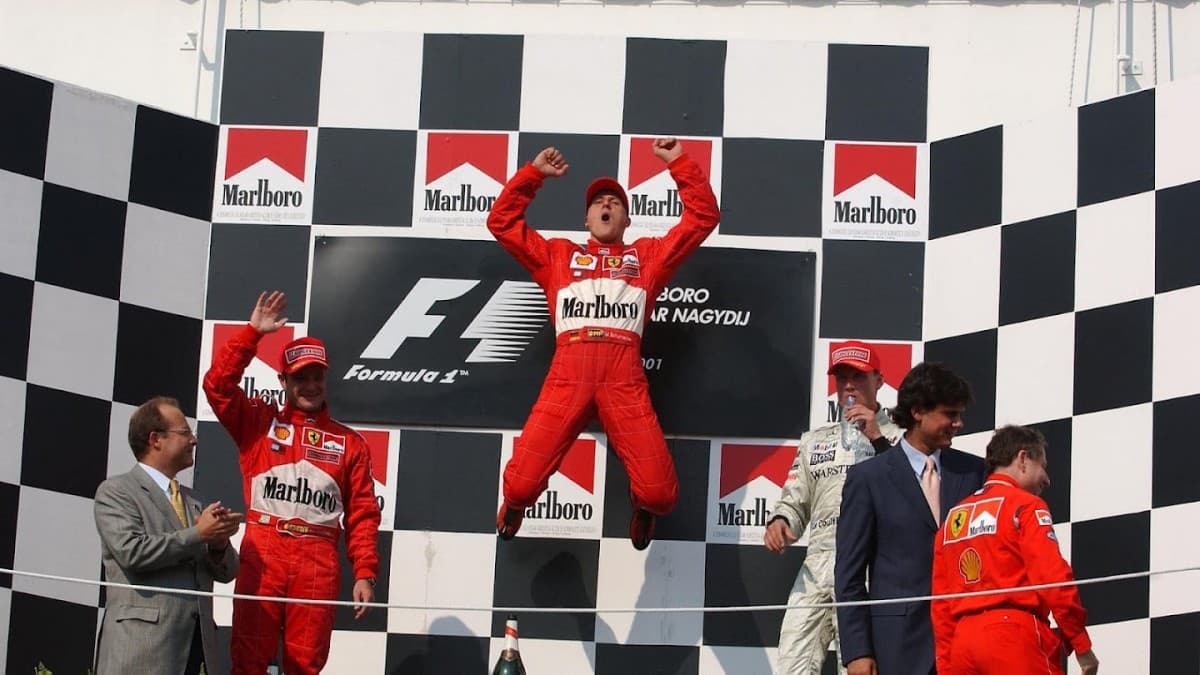
In 2000, the Ferrari driver ended the Scuderia's 21-year drought in the Drivers' Championship. Then he did it again in 2001, 2002, 2003, and 2004. Five straight. No one in the sport's history had done it before, and no one has done it since. The 2002 season was arguably the clearest statement of dominance: he finished on the podium in all 17 races and won 11 of them.
The 2004 season was the high-water mark. Thirteen wins from 18 races, including 12 of the first 13. Ferrari won 15 of the 18 rounds. For context, a driver winning nine or ten races in a modern season typically generates talk of an all-time great campaign. The Ferrari driver nearly doubled that total in a shorter calendar. What made the era so difficult to stop came down to three overlapping factors: mechanical consistency at the wheel, Ferrari's technical edge under Byrne's aerodynamic direction, and the strategic precision he and Brawn applied from qualifying through the final lap of every race weekend.
The Records That Still Define a Generation of F1
The numbers in full context
Seven world championships. Ninety-one race wins. Sixty-eight pole positions. One hundred and fifty-five podiums. And seventy-seven fastest laps, which remained the all-time record as of early 2026. That last number is worth dwelling on. Fastest laps are typically set in the closing stages of a race when drivers push hard on fresh rubber, they're an indicator of raw pace and racecraft under pressure. Michael Schumacher set more of them than anyone who has ever competed in Formula 1.
His wins record has since been surpassed by Lewis Hamilton. His pole position record has been matched and passed. But the fastest lap total sits there untouched, a number that reflects how reliably he could find pace when a race was nearly over. He also holds the record for most wins with a single team (72 with Ferrari), most wins at the same Grand Prix (8 at the French Grand Prix), and the only streak of five consecutive Drivers' Championships in the sport's history.
What was considered impossible before him
Before Michael Schumacher, Juan Manuel Fangio's five world championships were the benchmark, set across the 1950s and considered unreachable by most analysts. He passed it in 2003 and then won a sixth and seventh to remove any ambiguity about the comparison. For fans who came to F1 through the 2026 season, this is worth contextualizing: the way Max Verstappen's 2023 campaign felt staggering to modern audiences, the 2002-2004 Ferrari run created the same sensation for everyone watching at the time. The races didn't feel competitive in the same way. They felt like exercises in managing the margin.
How Michael Schumacher Compares to Hamilton, Verstappen, and the 2026 Era
The Hamilton parallel: same mountain, different path
Lewis Hamilton matched the record of seven titles in 2020 and holds the record for race wins at over 100. The numbers Hamilton has built are genuinely substantial, and the "greatest of all time" debate between the two remains one of the most contested conversations in the sport. But the comparison gets complicated fast. The German champion's era featured 16 to 18 races per season; Hamilton competed in 20 to 23. When accounting for schedule length alone, the raw win totals are measuring different things.
Their championship styles ran parallel in one important way: both drivers built sustained dominance around a technical partnership rather than pure individual talent. The Ferrari driver had Brawn and Byrne; Hamilton had Paddy Lowe and later James Allison at Mercedes. The machinery and the partnership mattered as much as the driver in both cases, which is exactly what makes the debate so difficult to resolve and so worth having. For more on F1 history and safety legacy, see our Niki Lauda 1976 comeback and Ayrton Senna profile.
What Verstappen's dominance echoes, and what GridLine Club is watching in 2026
Max Verstappen's 2023 season produced 19 wins from 22 races, surpassing the single-season record of 13. The win percentage was even higher: 86 percent versus 72 percent in 2004. Red Bull won 21 of 22 rounds that year, a level of constructors' dominance that even Ferrari at its peak didn't fully match.
The 2026 season brings a complete power unit regulation reset alongside new active aerodynamics rules, changes that have reshuffled the competitive order at the top of the grid. At GridLine Club, we're tracking whether any driver and team combination can build the kind of sustained, multi-season dominance that defined the Ferrari years. The pattern is already visible in the data: regulation resets historically create windows where one team solves the new formula faster than everyone else. The question for 2026 is who steps into that window first, and our technical deep dives, including Why Mercedes Is So Fast in 2026, try to answer exactly that.
The Full Picture, Wherever Your Search Started
If you came here looking for the F1 record books, you now have the complete picture: seven titles, 91 wins, 77 fastest laps that remain untouched, and a five-consecutive-championships streak that still stands alone. If you were searching for Schumacher fabrics or Schumacher Electric products, the links above have what you need: F. Schumacher & Co. for fabrics and wallcoverings and Schumacher Electric for battery chargers and jump starters.
For everyone staying in the F1 conversation: GridLine Club covers the season race by race, with the technical context and historical framing that makes each result make sense. Michael Schumacher's legacy isn't just historical, it's the measuring stick every dominant driver since has been held against, and the 2026 season is already raising new questions about where the sport's next chapter goes. Explore more on the site and About GridLine Club, the records are the starting point, not the whole story.